SSN Pattern's Special TestFlow
1. Non-Diagnosis TestFlow if all ssh are OCComp = off (Tester Compare Flow)
stateDiagram-v2
s1 : Tester Compare Flow
s1.1 : Setup for Initial Burst
s1.2 : Burst pattern(set)
s1.3 : Get failed core(ssh/icl) instance list
s1.4 : Is CMEM full?
s1.5 : Mask failed core(ssh/icl) instance
s1.6 : Summarize all failed cores

[*] --> s1
state s1 {
[*] --> s1.1
s1.1 --> s1.2
s1.2 --> s1.3
s1.3 --> s1.4
s1.4 --> s1.5 : Yes
s1.5 --> s1.2
s1.4 --> s1.6 : No
s1.6 --> [*]
}
1.1 Setup Initial Burst
// shall be encapsulated in C#RA, something like:
// TheLib.Setup.ssn.SetupCmemForInitialBurst();
TheHdw.Digital.CMEM.CentralFields = tlCMEMCaptureFields.AbsoluteCycle | tlCMEMCaptureFields.PatternName;
TheHdw.Digital.CMEM.SetCaptureConfig(-1, CmemCaptType.Fail, tlCMEMCaptureSource.PassFailData, true, false);
TheHdw.Digital.CMEM.CaptureLimitMode = tlDigitalCMEMCaptureLimitMode.Enable;
TheHdw.Digital.CMEM.CaptureLimit = maxFailsPerPin;
1.2 Burst pattern(set)
TheHdw.Patterns(ssnPatternSet).ExecuteSet(tlPatternSetResultType.Functional);
1.3 Get failed core(ssh/icl) instance list
var ssnTcResults = TheHdw.Digital.Patgen.ReadScanNetworkResults();
var failedCoreList = ssnTcResults.FailedCores;
1.4 Is CMEM full? 1.5 Mask-n-Reburst, 1.6 Conclude
1.5 Mask failed core(ssh/icl) instance and goto 1.2 burst pattern(set)
var ssnPattern = TheHdw.Digital.ScanNetworks[ssnMapfileName];
ssnPattern.CoreMasks.AddPerSite(failedCoreList);
ssnPattern.CoreMasks.Apply();
1.6 TC Flow Complete
2. Non-Diagnosis TestFlow if all ssh are OCComp = on (On-Chip Compare Flow)
stateDiagram-v2
s2 : On-Chip Compare Flow
s2.1 : Setup for Initial Burst
s2.2 : Burst pattern(set)
s2.3 : Get failed core(ssh/icl) instance list

[*] --> s2
state s2{
[*] --> s2.1
s2.1 --> s2.2
s2.2 --> s2.3
s2.3 --> [*]
}
2.1 Setup Initial Burst
The difference between TC and OCComp is that in OCComp user only cares about sticky_bit status. (all the sticky_bits) So before the Initial Burst of the pattern, it is better to Mask all output pins except the JTAG tdo pin.
2.2 Burst Pattern(set)
2.3 Get failed core(ssh/icl) instance list (by sticky_bit on tdo pin)
2.4 OCComp Flow Complete
3. TC + OCComp Joint Flow (None-Diagnosis)
stateDiagram-v2
s3 : TC + OCComp Joint Flow
s3.1 : Setup for Initial Burst (Mask all OCComp representative_ssh)
s3.2 : Burst pattern(set)
s3.3 : Get TC failed core(ssh/icl) instance list
s3.4 : Is CMEM full?
s3.5 : Mask TC failed core(ssh/icl) instance
s3.6 : Get OCComp failed core(ssh/icl) instance list
s3.7 : Are all TC core(ssh/icl) instances Masked?
s3.8 : Mask all compare pins except JTAG tdo
s3.9 : Summarize all failed cores

[*] --> s3
state s3 {
[*] --> s3.1
s3.1 --> s3.2
s3.2 --> s3.3
s3.3 --> s3.4
s3.4 --> s3.7 : Yes
s3.7 --> s3.8 : yes
s3.7 --> s3.5 : No
s3.5 --> s3.2
s3.8 -->s3.2
s3.4 --> s3.6 : No
s3.6 --> s3.9
s3.9 --> [*]
}
3.1 Setup Initial Burst
In this case, all representative_ssh instances shall be TC masked before Initial Burst since we don't want them to consume CMEM, and we don't need them to determine any OCComp ssh-icl-instance's pass fail status.
3.2 Burst Pattern(set)
3.3 Get TC failed core(ssh/icl) instance list
3.4 Is CMEM full? 3.5 Mask-TC-n-Reburst, 3.6 Get OCComp failed cores
If CMEM is NOT full, it means that all sticky_bit fails on JTAG tdo pin are captured completely.
3.5 Mask failed core(ssh/icl) instance and goto 3.2 Burst pattern(set)
var ssnPattern = TheHdw.Digital.ScanNetworks[ssnMapfileName];
ssnPattern.CoreMasks.AddPerSite(failedCoreList);
ssnPattern.CoreMasks.Apply();
in case that all TC core instances are masked and yet still the CMEM is full, it is possible that none-scan compares are eating up the CMEM. in which case we need to mask all output pins except the tdo pins just like what we do in 2.1 Setup for OCComp Initial Burst
3.6 Get OCComp failed core(ssh/icl) instance list (by sticky_bit on tdo pin)
3.7 TC+OCComp Joint Flow complete
4. Diagnosis Flow
Failures may be captured in:
- Internal scan chains if target core
- Wrapper chain of child core
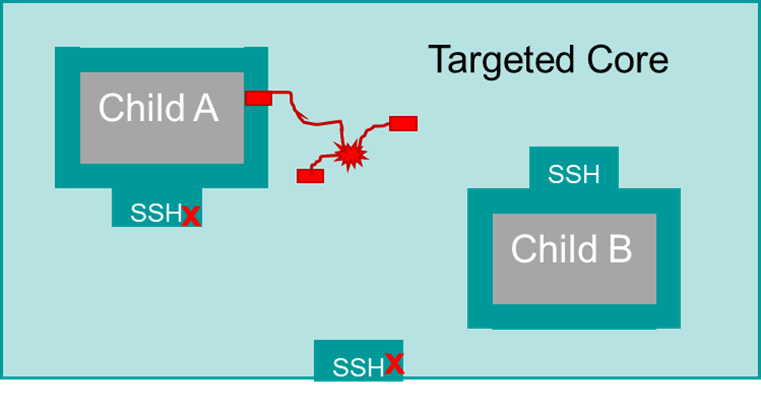 Failures from targeted core and child cores must be diagnosed together
And since TC + OCComp Joint Flow can cover the first two cases, we will only implement the TC + OCComp Joint Flow. So, the Diagnosis Flow shall be:
stateDiagram-v2
s3 : SSN SCAN None-Diagnosis Flow
s3.x : See ___TC + OCComp Joint Flow (None-Diagnosis)___
s4 : SSN SCAN Diagnosis Flow
s4.p : Parallel Diagnosis Flow
s4.s : Serial Diagnosis Flow

s4.1p : Enable as much failed cores as possible from the To-Be-Diagnosed List
s4.1s : Enable the next failed core in the To-Be-Diagnosed List
s4.2p : Setup Datalog for SCAN Diagnosis (DTR/STR)
s4.2s : Setup Datalog for SCAN Diagnosis (DTR/STR)
s4.3p : ReBurst Pattern(set)
s4.3s : ReBurst Pattern(set)


[*] --> s3
state s3 {
    [*] --> s3.x
    s3.x --> [*]
}

s3 --> s4 : need to get failed __ssh_icl_instance__ list before Diagnosis Flow
state s4 {
    [*] --> s4.p : Option 1, Test as many failed cores as possible for each reburst
    s4.p --> [*]
    [*] --> s4.s : Option 2, Test one failed core at a time for each reburst
    s4.s --> [*]
}

state s4.p {
    [*] --> s4.1p
    s4.1p --> s4.2p
    s4.2p --> s4.3p
    s4.3p --> s4.1p : if the To-Be-Diagnosed List is NOT empty
    s4.3p --> [*] : if the To-Be-Diagnosed List is empty
}

state s4.s {
    [*] --> s4.1s
    s4.1s --> s4.2s
    s4.2s --> s4.3s
    s4.3s --> s4.1s  : if the To-Be-Diagnosed List is NOT empty
    s4.3s --> [*]  : if the To-Be-Diagnosed List is empty
}
💡 Completing TC + OCComp Joint Flow is required before Diagnosis Flow
4.1 Setup Device for Diagnosing Failed Core(s)
- Serial Reburst: one failed core at a time
- Parallel Reburst: as many failed cores as possible per burst
4.2 Setup Datalog for SCAN Diagnosis
DTR and CONDITION_LIST of STR need to be configured before bursting the pattern
4.3 Burst Pattern(set)
(nothing special)